
Running a hotel involves managing many different activities at the same time. From reservations and check-ins to housekeeping, payments, guest communication and reporting, hotel staff need accurate information to keep operations running smoothly.
As a hotel grows, managing these activities manually can become increasingly difficult. Spreadsheets, notebooks, emails, phone calls and separate booking platforms can create disconnected information and increase the risk of errors.
This is where a hotel management system becomes important.
A hotel management system is software that helps hotels centralize and manage their daily operations. Depending on the solution, it can handle reservations, rooms, guests, housekeeping, payments, reporting, online bookings and other important hotel functions.
For hotels, lodges, resorts, guesthouses and other accommodation businesses, the right system can become an important part of both operational efficiency and business growth.
A hotel management system helps hotels manage reservations, rooms, guests, billing and daily operations from one platform.
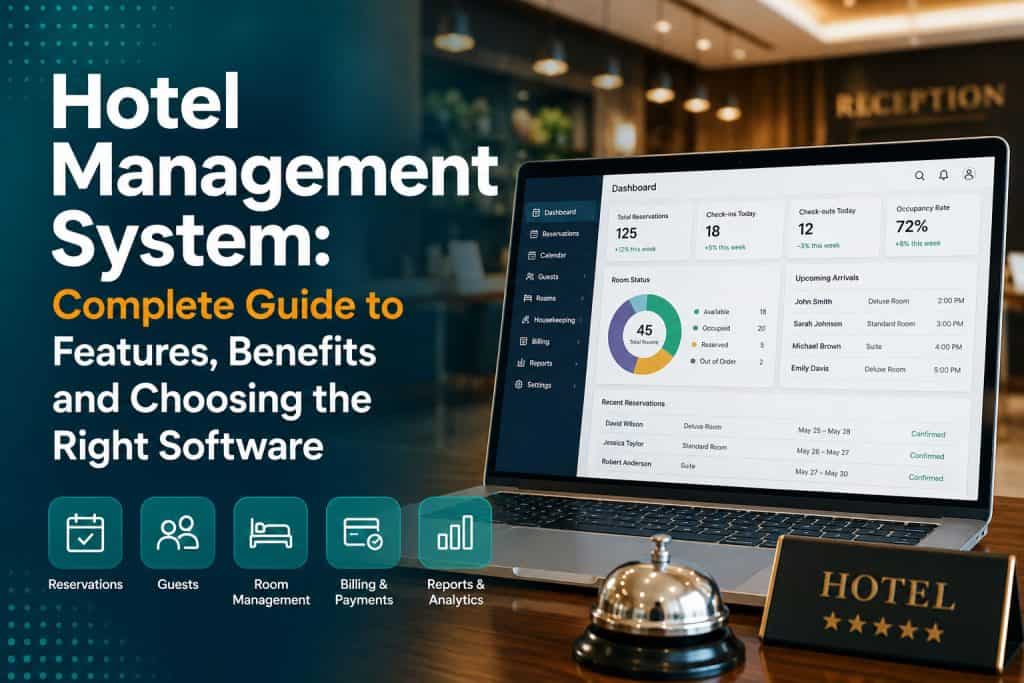
What Is a Hotel Management System?
A hotel management system is a software platform designed to help accommodation businesses manage their properties and daily operations.
Instead of managing different activities through separate tools, hotel employees can use a centralized system to manage important information.
A hotel management system may include features such as:
- Reservation management
- Room management
- Guest profiles
- Check-in and check-out
- Housekeeping
- Invoicing and payments
- Online bookings
- Channel management
- Reporting and analytics
- Hotel Revenue management
- Staff management
The exact features vary between software providers, so hotels should evaluate systems based on their specific requirements.
The most important consideration is not simply how many features a system has, but whether those features solve real operational problems.
Why Do Hotels Need a Hotel Management System?
Hotel operations can become complicated very quickly.
Imagine a hotel receiving bookings through its website, Booking.com, Expedia, travel agents, tour operators, WhatsApp, telephone calls and walk-in customers.
Every reservation affects room availability.
If information is not updated correctly, the hotel can experience problems such as:
- Double bookings
- Incorrect room availability
- Lost reservations
- Delayed check-ins
- Poor communication between departments
- Incorrect invoices
- Difficulty tracking revenue
A hotel management system helps bring these processes together.
Instead of relying on employees to remember or manually update information in multiple places, the system can provide a central source of operational information.
This becomes particularly valuable as the number of rooms, employees, reservations and booking channels increases.
Key Features of a Hotel Management System
Different hotel management systems offer different features. However, there are several capabilities that hotels should consider when evaluating software.
1. Reservation Management
Reservation management is one of the most important functions of hotel software.
The system should allow staff to create, modify and manage reservations while providing a clear view of room availability.
Staff should be able to see information such as:
- Guest name
- Arrival date
- Departure date
- Room type
- Number of guests
- Booking source
- Reservation status
- Payment status
A centralized reservation calendar can make it much easier for the front desk to understand what is happening at the property.
2. Room Management
Hotels need to know the status of every room.
A room may be:
- Available
- Occupied
- Reserved
- Dirty
- Being cleaned
- Out of order
- Ready for a guest
A hotel management system can help staff monitor these statuses and coordinate between reception and housekeeping.
This can reduce communication problems and make it easier to prepare rooms for arriving guests.
3. Guest Management
A hotel interacts with many guests, and maintaining accurate guest information is important.
A system can store information associated with reservations and guest stays.
Over time, this can help hotels understand guest history and provide more consistent service.
For example, if a returning guest previously stayed at the property, staff may be able to access relevant information without having to search through old paperwork.
Guest information can also support future marketing and customer relationship activities, subject to applicable privacy requirements.
4. Check-In and Check-Out
The front desk is one of the most important points of contact between a hotel and its guests.
A hotel management system can help staff manage arrivals and departures more efficiently.
During check-in, staff can confirm the reservation, assign the room and record relevant guest information.
During check-out, the system can help calculate outstanding charges and record payment.
This creates a more organized process for both employees and guests.
5. Housekeeping Management
Housekeeping has a direct impact on the guest experience.
A hotel may have rooms that have been checked out but are not yet ready for new guests.
Without an effective system, reception staff may need to repeatedly contact housekeeping to determine which rooms are available.
With integrated housekeeping functionality, staff can update room status as rooms are cleaned and inspected.
For example:
Guest checks out → Room becomes dirty → Housekeeping cleans room → Room is marked ready → Reception can assign room
This simple workflow can make daily hotel operations more efficient.
Hotel Management System and Online Bookings
Modern hotels often receive reservations from multiple sources.
These may include:
- Hotel websites
- Online travel agencies
- Travel agents
- Tour operators
- Corporate customers
- Telephone bookings
- Walk-in customers
A hotel management system can form the operational foundation for managing these reservations.
For hotels that want to increase direct bookings, integration with the hotel’s website can be particularly valuable.
Instead of sending every potential guest to a third-party booking platform, the hotel can provide an option to make a reservation directly through its own website.
This can give the hotel greater control over the customer relationship.
Hotel Management System vs Hotel Booking System
The terms hotel management system and hotel booking system are sometimes used interchangeably, but they can describe different things.
A hotel booking system primarily focuses on reservations.
It may allow customers to:
- View availability
- Select rooms
- Enter guest information
- Make payments
- Receive booking confirmation
A hotel management system is generally broader.
It can include reservations as well as:
- Guest management
- Room management
- Housekeeping
- Check-in and check-out
- Payments
- Reporting
- Staff operations
- Inventory
- Distribution
For a very small accommodation business, a booking system may be enough.
For a growing hotel, a more comprehensive hotel management system may be more appropriate.
Channel Management and Hotel Distribution
Hotels increasingly sell rooms through multiple channels.
For example, a hotel may list its rooms on several online travel agencies while also accepting direct bookings.
The challenge is maintaining accurate room availability across all these channels.
A channel manager can help synchronize room inventory and rates between the hotel’s property management system and external booking platforms.
This can reduce the administrative burden of manually updating every platform.
It can also help reduce the risk of accepting reservations for rooms that are no longer available.
Hotels that depend heavily on online distribution should therefore consider channel management capabilities when evaluating hotel software.
Reporting and Analytics
One of the biggest advantages of digital hotel management software is the ability to turn operational information into useful data.
Hotel managers need to understand how the property is performing.
Useful reports may include:
- Occupancy
- Revenue
- Average Daily Rate
- RevPAR
- Reservations
- Cancellations
- Booking sources
- Room performance
- Guest statistics
- Payment reports
This information can help management make better decisions.
For example, if a hotel discovers that a significant proportion of its bookings come from a particular channel, management can evaluate whether that channel is profitable and whether more effort should be invested in direct bookings.
Hotel Management Systems and Revenue Growth
A hotel management system does not automatically increase revenue.
However, it can provide the operational visibility needed to make better revenue decisions.
Consider a hotel that has good demand but poor visibility into its booking patterns.
Management may not know:
- Which room types sell fastest
- Which booking channels generate the most revenue
- When demand increases
- How far in advance guests book
- How many reservations are cancelled
- Which periods have low occupancy
A good hotel management system can make this information easier to analyze.
Management can then use the data to improve pricing, promotions, distribution and marketing.
This is where hotel technology connects with revenue management.
How Much Does a Hotel Management System Cost?
There is no single price for hotel management software.
Pricing can depend on:
- Number of rooms
- Number of properties
- Number of users
- Features required
- Integrations
- Online booking functionality
- Channel management
- Payment integrations
- Implementation
- Customer support
- Subscription model
Some systems charge monthly or annual subscriptions, while others may have additional charges for particular features or integrations.
Hotels should therefore compare the total cost of ownership rather than looking only at the advertised subscription price.
A more expensive system may provide better value if it significantly reduces manual work and operational errors.
How to Choose the Best Hotel Management System
Choosing hotel software should begin with the hotel’s operational requirements.
Before purchasing a system, ask the following questions.
Does it fit the size of your property?
A small guesthouse may have very different requirements from a large resort.
Avoid paying for complex features that your business does not need.
Is it easy for staff to use?
Hotel employees should be able to learn the system without excessive training.
A technically sophisticated system is not useful if staff avoid using it.
Does it support your booking channels?
If you receive bookings from OTAs, travel agents, tour operators and your own website, make sure the system can support your distribution model.
Does it provide useful reports?
Hotel management needs access to accurate data for decision-making.
Does it support direct bookings?
If increasing direct bookings is a priority, consider whether the system can connect to your hotel website and booking engine.
Can it integrate with other systems?
Your hotel may already use accounting software, payment systems, CRM tools or marketing platforms.
Integration can reduce duplication and improve the flow of information.
What support is available?
Consider how the provider handles technical support, onboarding, training and system problems.
Hotel Management Software for Hotels in Tanzania
Hotels operating in Tanzania can have particularly diverse booking and communication channels.
A property may receive customers through international booking platforms, local travel companies, tour operators, direct website bookings, social media, WhatsApp, telephone calls and walk-ins.
This makes coordination increasingly important.
A hotel management system can help create a more structured process for managing these different sources.
For example:
Marketing → Website → Booking → PMS → Guest Arrival → Payment → Reporting
When these processes are connected, management can gain a clearer understanding of how customers move from discovering the hotel to making a booking and eventually becoming returning guests.
Hotels in Tanzania should therefore evaluate software not only from an operational perspective but also from a sales, marketing and revenue perspective.
Hotel Management System Is Only One Part of Hotel Technology
Buying hotel software is not the end of a hotel’s digital transformation.
A modern hotel may need several connected technologies.
For example:
Hotel Website
↓
Booking Engine
↓
Property Management System
↓
Channel Manager
↓
Payment System
↓
CRM & Marketing
↓
Analytics & Reporting
Each component can have a different role.
The website attracts potential guests.
The booking engine converts them into reservations.
The PMS manages the stay.
The channel manager manages distribution.
The payment system handles transactions.
The CRM helps manage customer relationships.
Analytics helps management understand performance.
The objective should therefore be to build an integrated technology ecosystem rather than simply purchasing software because it has many features.
Common Mistakes When Choosing Hotel Software
Hotels can make several mistakes when selecting a management system.
Choosing based only on price
The cheapest system is not necessarily the best option.
A poor system can create additional work and operational problems.
Choosing too many features
More features do not automatically mean better software.
The system should match the hotel’s actual requirements.
Ignoring integrations
A system that cannot connect with important existing tools may create more administrative work.
Not involving staff
The people who will use the software every day should be involved in the evaluation process.
Focusing only on operations
Hotel software should also support the hotel’s broader business objectives, including revenue, distribution and customer relationships.
Final Thoughts
A hotel management system can become an important part of a hotel’s operational and digital infrastructure.
It can help manage reservations, rooms, guests, housekeeping, payments, reporting and online distribution while giving management better visibility into the business.
However, choosing the right system requires more than comparing feature lists.
Hotels should consider their size, booking channels, operational processes, technology requirements and growth objectives.
The best hotel management system is ultimately the one that helps the property operate more efficiently, understand its performance and create a better path from marketing to booking to guest experience and repeat business.
Need help evaluating your hotel’s technology?
Max Ayo Consultancy can help hotels and tourism businesses assess their digital marketing, websites, customer acquisition systems and technology infrastructure to identify opportunities for growth.
Talk to Max Ayo Consultancy about improving your hotel’s digital operations and customer acquisition.
Add your first comment to this post