
Businesses invest heavily in marketing to generate leads, but many struggle to convert those leads into paying customers. The missing link is often not the quality of the leads but the absence of an organized sales process. Without a structured approach, opportunities are forgotten, follow-ups are delayed, and revenue becomes unpredictable.
This is where CRM sales pipeline management becomes essential.
A well-managed CRM sales pipeline gives businesses complete visibility into every opportunity, from the first inquiry to the final sale. It helps sales teams prioritize prospects, automate repetitive tasks, forecast revenue, and ultimately close more deals.
Whether you’re a startup, SME, manufacturer, hotel, tour operator, professional service firm, or multinational organization, implementing CRM sales pipeline management can transform your sales performance and create a predictable growth engine.
In this guide, you’ll learn how CRM sales pipeline management works, why it matters, and how to build a sales process that consistently converts prospects into loyal customers.
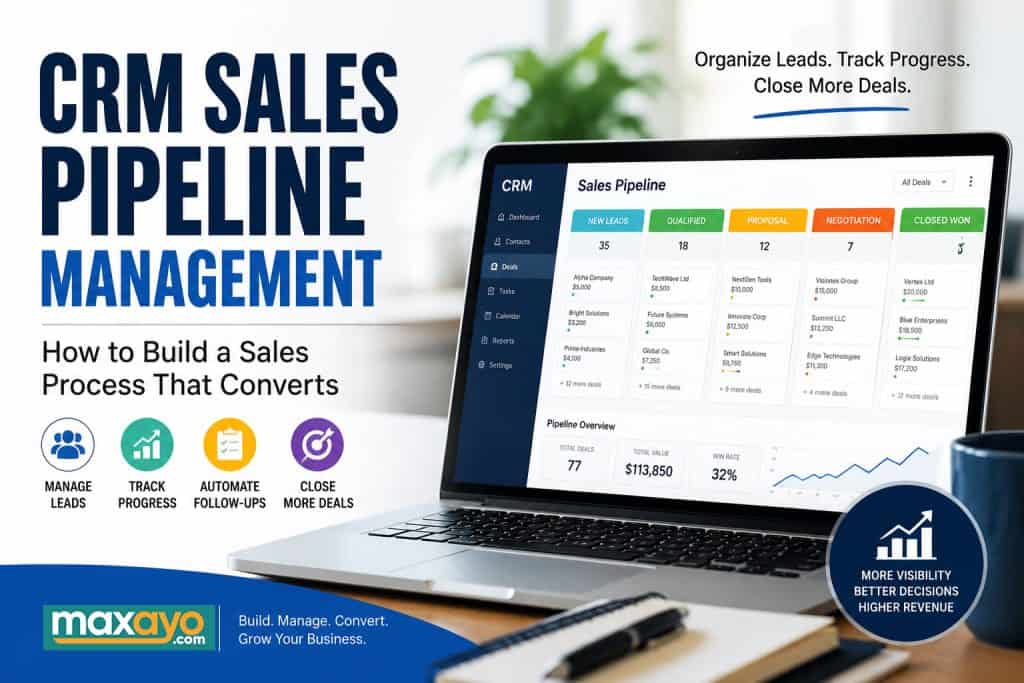
What Is CRM Sales Pipeline Management?
CRM sales pipeline management is the process of using a Customer Relationship Management (CRM) system to organize, track, and manage sales opportunities throughout the customer journey.
Instead of relying on spreadsheets, notebooks, emails, or memory, every lead is recorded inside the CRM and moved through predefined sales stages.
Typical information stored includes:
- Contact details
- Company information
- Communication history
- Meeting notes
- Follow-up tasks
- Sales value
- Expected closing date
- Documents and proposals
The CRM becomes the central hub where sales representatives, managers, and business owners can monitor every opportunity in real time.
Why CRM Sales Pipeline Management Matters
Many businesses lose revenue simply because there is no structured process for managing leads.
Common challenges include:
- Forgetting to follow up
- Losing track of conversations
- Sending proposals late
- Duplicate customer records
- Poor communication between team members
- No visibility into future revenue
CRM sales pipeline management solves these problems by creating a standardized sales process.
Key benefits include:
- Better lead organization
- Faster response times
- Increased conversion rates
- Improved customer experience
- More accurate sales forecasting
- Higher productivity
- Greater accountability
Businesses with organized sales pipelines typically outperform those relying on manual processes.
Understanding the Sales Pipeline
A sales pipeline is a visual representation of every stage a prospect goes through before becoming a customer.
Think of it as a roadmap that guides your sales team through the buying journey.
Each stage represents progress toward closing a deal.
Instead of asking:
“Did we contact this client?”
You immediately know:
- Where the deal is
- Who owns it
- What’s the next action
- When the follow-up is due
- Probability of closing
Essential CRM Sales Pipeline Stages
Although every business is different, most successful sales pipelines include the following stages.
1. New Lead
A prospect enters your business through:
- Website enquiry
- Google Ads
- Facebook Ads
- Referral
- Phone call
- Trade show
At this stage the objective is to collect basic information.
2. Qualified Lead
Not every enquiry becomes a customer.
Qualification determines whether the prospect:
- Has a genuine need
- Has purchasing authority
- Has budget
- Fits your target market
- Is ready to buy
Qualification helps your team focus on opportunities with the highest probability of success.
3. Discovery Meeting
This stage focuses on understanding the customer’s challenges.
Topics discussed include:
- Business goals
- Current challenges
- Budget
- Timeline
- Decision makers
- Expected outcomes
A successful discovery meeting builds trust and positions your business as a problem solver rather than simply a vendor.
4. Proposal Sent
After understanding customer needs, prepare a professional proposal including:
- Scope of work
- Pricing
- Timeline
- Deliverables
- Terms
Your CRM should record:
- Proposal date
- Proposal version
- Expected decision date
5. Negotiation
Many deals require additional discussions.
Typical negotiation topics include:
- Price adjustments
- Delivery timelines
- Contract terms
- Payment schedules
- Additional services
Recording negotiation history inside your CRM ensures everyone remains informed.
6. Contract Signed
Once the proposal is accepted:
- Sign agreements
- Issue invoices
- Begin onboarding
- Assign project managers
This stage marks the transition from sales to project delivery.
7. Closed Won
Congratulations.
The prospect has officially become a customer.
However, the sales process shouldn’t end here.
Use your CRM to:
- Request testimonials
- Upsell additional services
- Schedule follow-up meetings
- Monitor customer satisfaction
Customer retention is often more profitable than acquiring new clients.
8. Closed Lost
Not every opportunity converts.
Instead of deleting lost deals, record the reason.
Examples include:
- Budget constraints
- Competitor selected
- No longer interested
- Project postponed
- Internal approval delayed
This data helps improve future sales strategies.
Building a High-Converting CRM Sales Pipeline
A successful sales pipeline is simple, measurable, and repeatable.
Step 1: Define Clear Pipeline Stages
Avoid creating too many stages.
Most businesses perform well with between six and eight stages.
Each stage should represent a meaningful step toward closing the deal.
Step 2: Assign Deal Owners
Every opportunity should have one person responsible for:
- Communication
- Follow-up
- Proposal preparation
- Closing
Ownership eliminates confusion and improves accountability.
Step 3: Set Deal Probabilities
Assign probabilities to estimate revenue.
Example:
- New Lead — 10%
- Qualified — 30%
- Discovery — 50%
- Proposal — 70%
- Negotiation — 85%
- Contract Sent — 95%
- Closed Won — 100%
Forecasting becomes much more accurate.
Step 4: Schedule Every Follow-Up
One of the biggest sales mistakes is ending conversations without scheduling the next action.
Every deal should always have:
- Next task
- Due date
- Assigned owner
Never allow opportunities to become inactive.
Step 5: Automate Routine Activities
Modern CRM systems automate repetitive tasks.
Examples include:
- Welcome emails
- Appointment reminders
- Follow-up sequences
- Proposal notifications
- Internal task assignments
- Lead routing
Automation saves time while ensuring consistency.
CRM Sales Pipeline Metrics to Track
Successful businesses continuously measure performance.
Important KPIs include:
Lead Conversion Rate
Percentage of leads becoming customers.
Average Deal Size
Average revenue generated per customer.
Sales Cycle Length
How long it takes to convert a prospect into a customer.
Win Rate
Percentage of deals successfully closed.
Pipeline Value
Total potential revenue currently in your sales pipeline.
Follow-Up Response Time
How quickly sales representatives respond to enquiries.
Faster responses often lead to higher conversion rates.
Common CRM Sales Pipeline Mistakes
Many businesses invest in CRM software but fail to achieve results.
Common mistakes include:
Using CRM as an Address Book
A CRM should manage relationships, not simply store contacts.
Inconsistent Data Entry
Incomplete information makes reporting unreliable.
Establish clear standards for updating records.
No Sales Process
Technology alone cannot solve poor sales management.
Document your sales process before implementing software.
Too Many Pipeline Stages
Complex pipelines confuse sales teams.
Keep stages simple and easy to understand.
Ignoring Lost Opportunities
Analyze every lost deal.
Understanding why customers don’t buy helps improve future sales.
Best CRM Software for Sales Pipeline Management
Many excellent CRM platforms are available.
Popular options include:
HubSpot CRM
Excellent for small and growing businesses.
Features:
- Free CRM
- Email tracking
- Deal pipeline
- Automation
- Reporting
- Meeting scheduling
Salesforce
Suitable for larger enterprises requiring advanced customization.
Zoho CRM
Affordable solution with comprehensive sales features.
Pipedrive
Designed specifically around visual sales pipeline management.
Monday CRM
Ideal for organizations wanting flexible workflow management.
Automating Your Sales Pipeline
Automation is becoming one of the biggest competitive advantages in sales.
Examples include:
- Automatically assigning leads
- Sending welcome emails
- Creating follow-up tasks
- Scheduling reminders
- Updating deal stages
- Sending proposal reminders
- Triggering customer onboarding
Businesses that automate repetitive work allow sales teams to spend more time building relationships.
CRM Sales Pipeline Management Best Practices
Successful organizations follow consistent habits.
Review your pipeline daily
Sales managers should review open opportunities every day.
Maintain clean customer data
Accurate information improves reporting and forecasting.
Focus on qualified opportunities
Not every lead deserves equal attention.
Prioritize deals with the highest conversion potential.
Use dashboards
Visual dashboards help managers quickly identify bottlenecks.
Train your sales team
Even the best CRM software requires user adoption.
Regular training improves performance.
The Future of CRM Sales Pipeline Management
Artificial Intelligence is transforming how businesses manage customer relationships.
Modern CRM platforms now assist with:
- Lead scoring
- Predictive forecasting
- Automated email generation
- Conversation summaries
- Customer insights
- Smart recommendations
Rather than replacing sales professionals, AI helps them work more efficiently and focus on building stronger customer relationships.
Businesses that combine CRM systems with AI-powered automation are better positioned to scale and compete in increasingly global markets.
How Max Ayo Consultancy Can Help
Implementing CRM sales pipeline management is about more than installing software. It requires designing a sales process that matches your business goals, training your team, and automating key workflows.
At Max Ayo Consultancy, we help businesses build scalable sales systems through:
- CRM implementation and customization
- Sales pipeline design
- HubSpot CRM setup
- Lead management automation
- Sales reporting dashboards
- Email marketing automation
- AI-powered sales workflows
- Customer onboarding processes
- Team training and CRM adoption
Whether you’re launching a new business, growing your sales team, or expanding into international markets, we can help you build a CRM sales pipeline that converts more leads into long-term customers.
Conclusion
An effective CRM sales pipeline is the foundation of predictable business growth. By organizing every opportunity, standardizing follow-ups, and leveraging automation, businesses can improve efficiency, increase conversions, and create a more consistent customer experience.
The most successful companies don’t leave sales to chance, they rely on structured processes supported by the right technology.
If your business is still managing leads through spreadsheets or scattered emails, now is the time to invest in CRM sales pipeline management. With a clear process and the right CRM in place, you’ll spend less time chasing information and more time closing deals, building stronger customer relationships, and driving sustainable growth.
Add your first comment to this post